


For years, penetration testing has occupied a peculiar place in the cybersecurity landscape. Everyone agrees it is essential. Everyone knows it should happen more often. And yet, for the vast majority of organizations, it remains an infrequent, expensive, and painstaking exercise — conducted once a year, driven more by compliance deadlines than genuine security conviction. AI is about to change all of that, fundamentally and permanently.
The Traditional Engagement: A Four-Week Journey
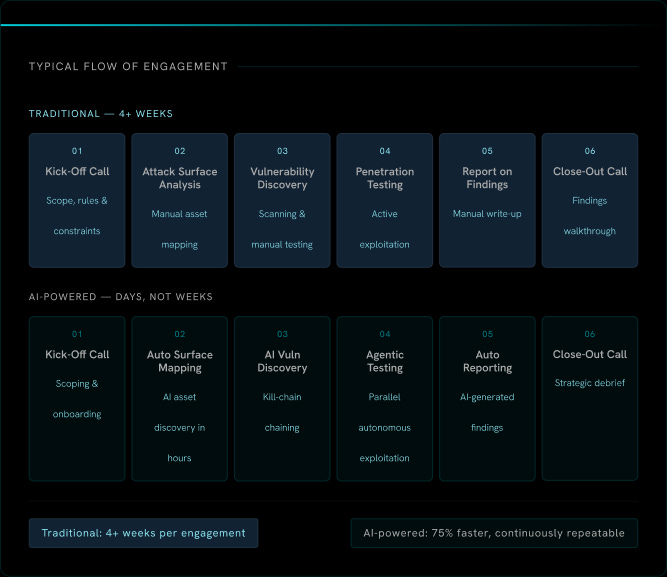
To understand how significant this shift is, it helps to walk through what a traditional penetration testing engagement actually looks like. The process follows a structured six-step flow that, end to end, typically consumes at least four weeks of calendar time.
Kick-Off Call
Every engagement begins with a Kick-Off Call — a scoping session where the client and testing team align on objectives, rules of engagement, systems in scope, and any constraints or sensitivities. Necessary as it is, this phase alone can take days of back-and-forth scheduling and documentation before a single test is run.
Attack Surface Analysis
From there, the team moves into Attack Surface Analysis — a methodical process of mapping the target environment, identifying externally exposed assets, cataloguing services, reviewing architecture, and building a picture of how an attacker might approach the target. This reconnaissance phase demands significant manual effort and experienced judgment.
Vulnerability Discovery
Vulnerability Discovery follows, where testers use a combination of automated scanning tools and manual techniques to surface weaknesses across the attack surface. But unlike a simple vulnerability scan, penetration testers go further — attempting to understand how discovered weaknesses chain together and which ones represent genuine, exploitable risk.
Penetration Testing
The heart of the engagement is the Penetration Testing phase itself — active exploitation where testers attempt to breach systems, escalate privileges, move laterally, and demonstrate the real-world impact of discovered vulnerabilities. This is the most skilled, time-intensive phase, often consuming the better part of two weeks for a complex environment.
Report on Findings
Once testing is complete, the team compiles a comprehensive Report on Findings — a document covering project scope, assumptions and constraints, a summary of major findings, strategic recommendations for limiting exposure, technical descriptions of each vulnerability, the anatomy of exploitation or penetration achieved, technical and business risk assessments, and prioritized remediation recommendations. Writing a report of this quality takes days.
Close-Out Call
The engagement closes with a Close-Out Call, where findings are walked through with the client team, questions are answered, and next steps are agreed upon.
Six phases. Four weeks minimum. Significant cost. And when it is over, the organization is left with a snapshot of their security posture — accurate on the day the report was written, but aging by the hour.
What AI Changes — and How Dramatically
AI does not just accelerate a few steps in this process. It compresses the entire engagement timeline by at least 75%, turning a four-week exercise into something achievable in days.
During the Attack Surface Analysis phase, AI-powered tools can autonomously map an organization’s exposed assets, enumerate services, and build a comprehensive picture of the attack surface in hours rather than days. Machine learning models trained on offensive security methodologies identify patterns and relationships in the data that would take a human analyst significantly longer to uncover.
Vulnerability Discovery is where AI delivers its most dramatic improvement. Modern AI agents do not simply scan for known CVEs. They actively reason about the target environment, identify chained weaknesses, and prioritize findings based on real-world exploitability rather than theoretical severity scores. Findings are validated, contextualized, and tied to real kill chains, eliminating the false positives that waste analyst time.
The Penetration Testing phase itself — traditionally the most labor-intensive — is being transformed by agentic AI systems capable of executing complex offensive workflows autonomously. Agent orchestration, swarm architectures, and inter-agent communication protocols can now replicate the sophisticated decision-making that previously required senior human testers. Critically, AI does not stop after finding one viable route into a system. It continues exploring every available attack path simultaneously, producing a far more complete picture of risk.
75% Reduction in engagement time AI-powered penetration testing compresses what traditionally took four weeks into a matter of days, with a corresponding reduction in cost that makes the service significantly more accessible.
Reporting, too, benefits enormously. AI can generate structured, detailed findings reports in a fraction of the time it takes a human analyst to write from scratch, automatically mapping vulnerabilities to business risk, suggesting remediation priorities, and structuring output in formats immediately useful to both technical and executive audiences.
From Point-in-Time to Always On
Perhaps the most profound shift AI enables is not speed — it is continuity. For decades, penetration testing has been a point-in-time exercise. An organization might pass their annual test in January, then spend the following twelve months in the dark as their environment changes, new assets come online, new vulnerabilities are disclosed, and new attack techniques emerge. The compliance checkbox is ticked, but genuine security insight evaporates almost immediately.
AI-powered platforms are built around a fundamentally different philosophy. Rather than a once-a-year engagement, organizations get a persistent offensive simulation environment — essentially a permanent red team operating around the clock, every day of the year.
Platforms like Armadin are at the forefront of this shift. Founded by Kevin Mandia — the cybersecurity leader who built Mandiant — Armadin raised nearly $190 million to build an agentic AI platform that deploys a swarm of specialized AI agents trained on decades of real-world red team methodology. These agents plan, reason, adapt, and attempt real exploitation paths rather than merely identifying theoretical vulnerabilities, chaining weaknesses across identity systems, applications, infrastructure, and cloud configurations continuously.
This shift has enormous implications for how organizations think about their security posture. Instead of asking “were we secure enough to pass our annual test?”, they can ask “are we secure right now, today?” and get a real answer. Daily situational awareness replaces the quarterly or annual snapshot that was previously the best most organizations could hope for.
Better Security at a Lower Cost
When AI reduces the time and cost of a penetration testing engagement by 75%, the economics of the service change fundamentally. Penetration testing stops being a luxury reserved for large enterprises with generous security budgets and becomes something any organization can access routinely. The penetration testing market is projected to grow from $1.98 billion in 2025 to $4.39 billion by 2031, driven precisely by this democratization.
Organizations that previously ran a single annual test because of cost constraints can now run continuous assessments. Those motivated purely by compliance can discover that continuous testing provides something compliance never could: genuine, real-time confidence in their defenses.
The Bottom Line
The four-week, high-cost, once-a-year penetration testing engagement is not disappearing — but it is being fundamentally redefined. AI compresses timelines, eliminates false positives, explores more attack paths, and generates better reporting. More importantly, it transforms penetration testing from a periodic compliance ritual into a continuous, intelligence-driven practice that mirrors the pace of the real threat environment.
Organizations that embrace this shift will not just save time and money. They will finally have the kind of continuous, honest picture of their defenses that good security has always demanded — and that only AI can now realistically deliver.